
Research indicates that corporate matching gift programs can increase response rates by 71% and donation amounts by 51%, yet more than 78% of supporters remain completely unaware that their employers offer these incentives.
To bridge this divide, forward-thinking organizations must use targeted communication strategies that meet donors precisely where they are. Luckily, email serves as a direct pipeline for educating (and activating) supporters immediately after they engage with your organization. This captures their attention while your mission is still top of mind, resulting in exceptionally high performance metrics that exceed those of standard fundraising outreach.
Ready to unlock corporate support? Let’s dive in with our first tip for scaling your matching gift campaigns.
 1. Send emails within 24 hours, while the donor is active.
Timing is everything in digital fundraising, as the window for heightened engagement closes quickly after a gift is completed. For this reason, the 24 hours immediately after receiving a donation are ideal for triggering post-transaction matching gift follow-up emails.
By reaching out while the emotional connection remains strong, nonprofits can drastically increase their email response rates. Waiting days or weeks to follow up diminishes your message's urgency, reducing the likelihood that the individual takes action.
To take full advantage of this initial momentum, audit your payment gateway processing speeds to ensure transaction data syncs to your communication tools without delays (including on weekends, holidays, and high-volume giving periods).
2. Use deep personalization to drive immediate action.
Modern donors expect digital interactions to reflect their relationship with your organization. When messages lack personalized context, supporters treat them as spam and hit delete without reading.
For this reason, high-converting matching gift emails rely on dynamic data injection to make the request feel tailored and urgent.
To increase engagement, your message should include the donor’s name, their recent gift amount, and their current employer.
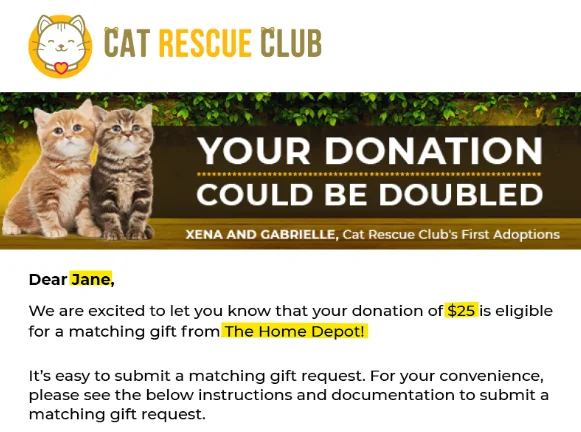
These unique data points simplify the individual’s journey by providing step-by-step instructions with direct links to complete a match. Removing the need for donors to conduct external research in order to locate the right forms eliminates a major point of drop-off.
Because MonkeyPod is both your fundraising and your email marketing platform, you can use merge tags to populate information like the donor’s name, their total donations, and link to their Community Portal where they can see their donations and download receipts.
If a donor’s employer remains unknown, pivot to a call to action that invites the individual to search for their company using an embedded lookup tool.
3. Send emails from your own domain to establish credibility.
In an era of rising cybersecurity threats, donors are highly sensitive about online security, particularly when an email asks them to handle financial data or click external links. If a matching gift email appears to come from an unrecognized third-party platform, donors (or their email providers) will likely flag it as spam or phishing, which can harm your deliverability.
Therefore, sending emails from a verified domain is essential for maintaining trust and establishing an authentic digital identity. Not to mention, using your official brand connects the email directly to the transaction the donor just completed.
Leading fundraisers also recommend signing your matching gift emails from a specific person within your organization, too, such as your head of development or executive director. This helps put a face to the ask and increase conversions, making it a “no-brainer” to complete a match.
We recommend working with your organization’s IT administrator to implement SPF, DKIM, and DMARC authentication protocols on your sending domain to ensure that your automated outreach reaches the intended recipients.
When you configure email sending in MonkeyPod, you’ll be prompted to create the DNS records you need to ensure your emails are authenticated. This makes it easy to ensure you land in your donor’s inbox.
4. Simplify self-reporting to track matching gift submissions.
Fundraising teams often struggle with a lack of visibility into the matching gift pipeline because corporations rarely notify nonprofits when an employee initiates a request.
The good news is that a simple interactive element within your email can solve this data blind spot. By turning the donor into an active participant in the tracking process, you can gain real-time insights into incoming revenue.
Here’s how it generally works:
Outreach emails should include a clear, prominently placed button that reads “I’ve submitted my match.”
This simple one-click action allows the supporter to notify your development team that they’ve completed their part of the process. (Hint: this closing action gives donors an immediate sense of accomplishment.)
An automated workflow then updates the donor’s status in your workplace giving platform to “matching gift pending,” thereby pausing further reminders and preventing communication fatigue.
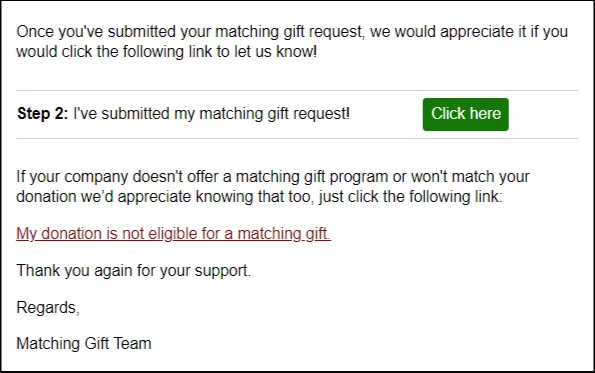
Enabling self-report functionality for donors provides your team with accurate pipeline data, making it easy to track gifts from initiation to completion and to forecast incoming revenue with greater accuracy. Plus, it helps improve nonprofit accounting workflows once the match is disbursed, allowing teams to more easily reconcile the final payout with the initial donor’s gift!
5. Close the loop with a dedicated thank-you email.
The matching gift process should never feel like a transactional exchange. Rather, it’s an opportunity to deepen the donor relationship.
When a corporation fulfills a match, it can be easy to forget that a human being initiated that revenue stream. Closing the loop with a personalized acknowledgment reinforces that their effort had a tangible, real-world impact.
A strategic post-match thank-you workflow should:
Acknowledge corporate impact. Once your organization receives the matching funds from the corporation, your communication journey is not over. Nonprofits must treat the arrival of corporate funds as a shared victory.
Reinforce donor generosity. Send a dedicated follow-up email to the initial donor, letting them know that their extra effort successfully doubled their contribution. For instance, a regional community health clinic could send a note explaining that the donor's original contribution, combined with their employer's match, would fund twice as many prenatal checkups.
Foster long-term retention. Expressing specific gratitude builds deep loyalty and directly encourages matching gift participation for future gifts, too. Donors who see the tangible results of their advocacy are highly likely to repeat the process during your next campaign.
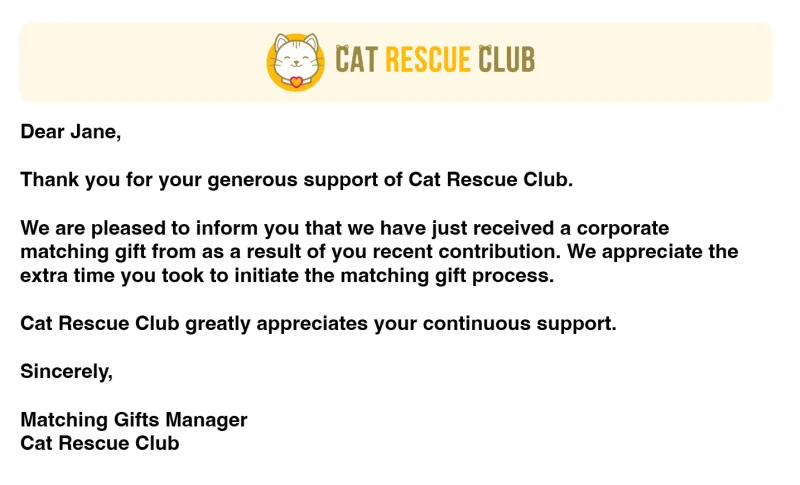
To maximize the impact of this final touchpoint, consider including a quote or a brief video from your program staff showing the direct result of the doubled funding.
6. Eliminate fundraising friction using modern automation tools.
While the best practices outlined above are highly effective, execution becomes a significant operational challenge when managed alone. As an organization scales its fundraising, tracking corporate guidelines, personalizing messages, and monitoring match statuses becomes impossible to keep up with manually.
Embracing specialized automation systems (such as MonkeyPod and Double the Donation) is the only way to scale this revenue channel without burning out your development team. This powerful integration instantly identifies match-eligible donations by cross-referencing donor employment data against a massive repository of corporate giving programs, triggering the appropriate reminders and ensuring no transactions slip through the cracks.
The result? Automated identification and tech-powered email marketing allow your team to raise more from corporate matching gifts while saving hours of staff time.
Final thoughts & next steps
Implementing these email best practices transforms standard donor acknowledgments into active revenue generators. Removing the operational burden of chasing corporate matches enables your organization to achieve predictable, ongoing revenue streams.
Combining a smart email communication framework with innovative tools like the Double the Donation and MonkeyPod integration allows nonprofits to grow revenue while focusing their energy on advancing their missions. To truly maximize your results, be sure to regularly audit your outreach metrics and continuously refine your email content to ensure your supporters receive the information they need to get involved in workplace giving.
To check out some examples of organizations seeing success with matching gift email outreach, check out this inspirational blog.