Quick answer: Easy nonprofit accounting software isn't just software with a friendlier menu bar — it's software that enforces fund accounting rules automatically, so a bookkeeper without an accounting degree can't accidentally mix restricted and unrestricted money, misclassify a grant, or hand the board a report that doesn't tie out. MonkeyPod was built around that definition of "easy": nonprofit accounting rules built into the chart of accounts from day one, not bolted on as a workaround.
The learning curve problem with QuickBooks and Aplos for nonprofits
The learning curve problem with these tools is that they either weren't designed for nonprofit rules at all (QuickBooks) or they expose those rules directly to the user and expect them to understand everything (Aplos). Either way, the software isn't easy to use.
QuickBooks can be difficult for nonprofits to use because it's built for small businesses, not nonprofits. It can't manage the unique needs of nonprofit accounting and you will likely need to have intermediate accounting skills. Aplos was built for churches, so it works for many nonprofits, but it's difficult to track restricted and reimbursable grants without significant customization.
QuickBooks does have a nonprofit edition, but it’s really the same for-profit accounting engine with a different label. You can make it track restricted funds and program budgets, but you'll need to get creative and use classes, accounts, projects, and other features to do so. As your accounting becomes more complex, maintaining accurate fund-level reporting can require significant bookkeeping knowledge and carefully designed workarounds.
Because Aplos was built specifically for nonprofits and small churches, it understands fund accounting conceptually in a way QuickBooks doesn't. But nonprofit-specific doesn't automatically mean beginner-friendly. Fund accounting is still fund accounting: debits, credits, and fund balances that need to net to zero. Aplos doesn't provide many automations, so even though the software is built around those concepts, you still need to complete a lot of the work manually. Plus, depending on the features you need, you may have to pay more.
How MonkeyPod simplifies fund accounting
MonkeyPod makes nonprofit fund accounting easy by building the nonprofit rules directly into the platform, so the software does the work instead of the person. Donations can be logged and restricted automatically. Releasing restricted funds to cover expenses is simple. And you build your reports as you go rather than cobbling them together at the end of the year.
A few concrete examples of what that looks like in practice:
Ready for nonprofit accounting from day one
A new MonkeyPod account includes a purpose-built chart of accounts with safeguards that enforce nonprofit accounting rules automatically. The functional categories the IRS requires you to report on are built into MonkeyPod as classes. You're not left to configure classes and workarounds to approximate fund accounting.
Contributed vs. earned income is distinguished automatically
A ticket sale and a donation aren't the same thing in nonprofit accounting, and MonkeyPod treats them differently from the moment they're recorded, without you having to remember to flag it.
Native fund tracking and budgeting
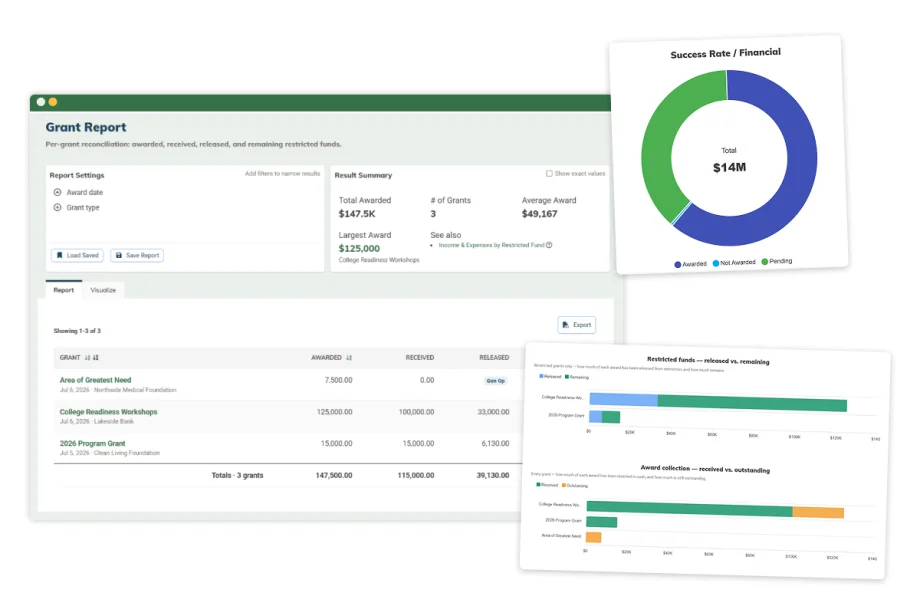
Restricted and unrestricted funds are tracked and reported as a native feature, not a manual workaround layered on top of the software.
Budgets sync to actuals in real time, for grants, programs, and events — so "are we on track with this grant?" is a report you can pull, not a spreadsheet you have to rebuild.
Generate end-of-year reports automatically
The standard nonprofit financial statements the IRS requires are built into MonkeyPod. The Statement of Activities, Statement of Financial Position, and Statement of Functional Expenses are built the way nonprofit accounting requires, not adapted from a for-profit template.
MonkeyPod makes it easier to receive donations and grants
With MonkeyPod, donations, grants, and sales all flow into the same system that runs your CRM and email. That means most of the entries a bookkeeper or fundraiser would otherwise create by hand (recording a gift, tagging its fund, updating the donor record) happen automatically when the transaction occurs. Less manual entry means fewer chances to make the kind of small classification mistake that turns into a big headache at audit time.
Without it built in, a bookkeeper records a restricted grant payment, manually tags it to the right fund or class, cross-checks it against a separate budget spreadsheet, and hopes the numbers are correct. With fund accounting built in, the grant payment is recorded once, the system already knows it's restricted, and the budget-to-actuals report is always up to date.
Here's how the usual options compare for someone without an accounting background:
Spreadsheets | QuickBooks | Aplos | MonkeyPod | |
|---|---|---|---|---|
Enforces fund restrictions automatically | No — you are the only safeguard | No — manual classes and workarounds | Yes, but you manage the mechanics | Yes — built into the chart of accounts |
Requires an accounting background to set up | Yes, in practice | Some | Some | No |
Donor and accounting data in one system | No | No | No — CRM-light | Yes |
Learning curve for a non-accountant | Low, but error-prone | Medium–High | Medium | Low |
If you want the full side-by-side on pricing and specific features, our nonprofit accounting software comparison breaks down MonkeyPod, QuickBooks, and Aplos side by side.
How long does it take to learn MonkeyPod's accounting tools?
Most users without an accounting background are comfortable using MonkeyPod day-to-day in just a couple of weeks, since the platform is built to help with nonprofit accounting compliance. Full onboarding, including migrating your historical data, can take up to a month. Every new MonkeyPod user works with a dedicated implementation specialist, so you won't be doing it on your own.
You also get access to free weekly drop-in office hours and unlimited email support from real nonprofit veterans, not a chatbot, so new users aren't left to figure out fund accounting concepts alone.
New to nonprofit bookkeeping altogether? Our complete guide to nonprofit accounting software walks through fund accounting fundamentals, Form 990 and FASB prep, and a step-by-step plan for migrating off spreadsheets.
Every nonprofit's books look a little different, and the fastest way to see how this works for yours is to look at it directly. Learn more about MonkeyPod's nonprofit accounting tools, or schedule a demo with our team. We're happy to walk through your specific fund accounting setup.